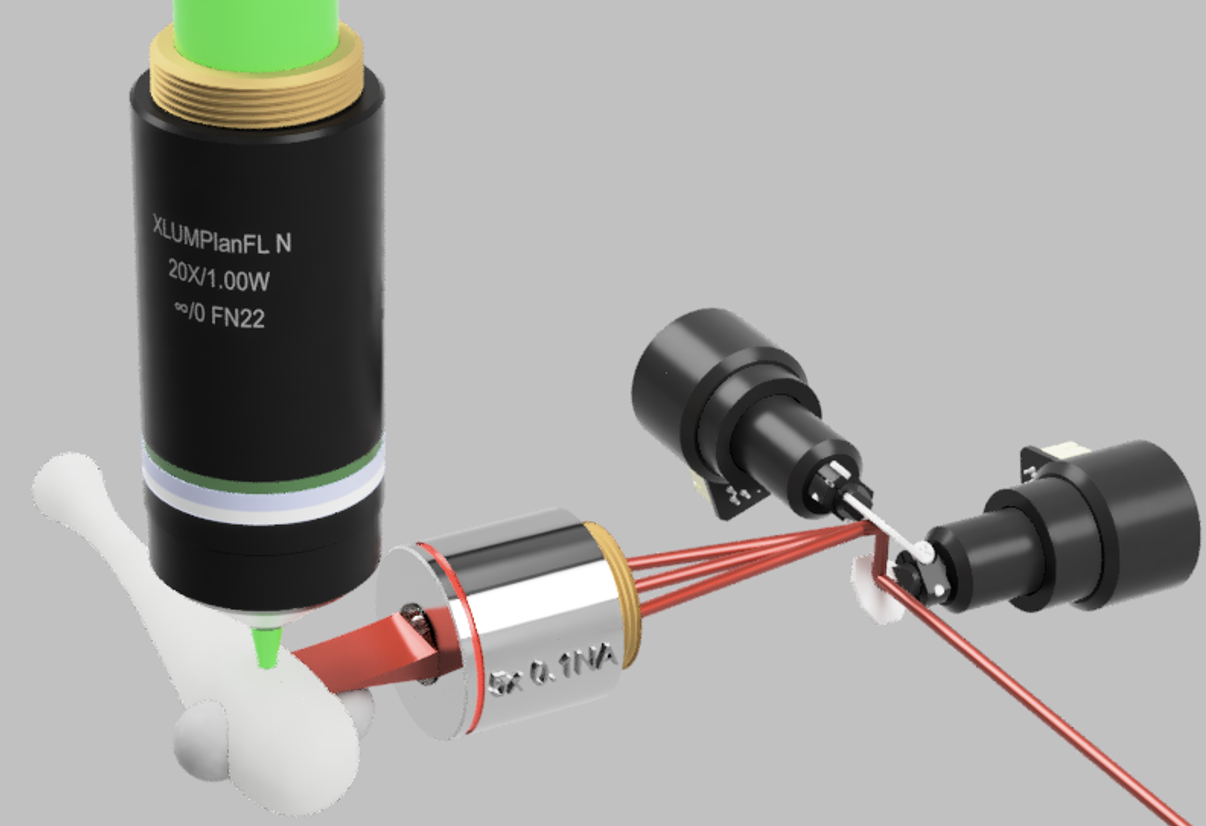
Light sources#
Light generation and delivery to sample is foundational problem in microscopy. Light sources can be specified by few characteritics such as:
spectral content: which wavelengths are present in the light source? How wide is the spectrum?
frequency of modulation: is it a pulsed source or continous-wave?
control: can we electronically control amplitude or frequency of light?
is the light polarized?
is the light coherent? (in case of lasers)
is the light collimated when leaving the light source?
what is the shape of the light beam?
Laser sources#
Laser sources can provide coherent light with narrow (from 0.01nm for continuous-wave sources to >20nm for femtosecond pulsed laser) spectrum, well-defined polarization, high-quality beam shape, and stable frequency (in case of pulsed lasers). Multiple lasers with different wavelengths can be packaged into a single device, coupled into a single optical fiber for compact and efficient delivery to the imaging setup. Ideally, we want a device where amplitude of each laser output can be independently modulated.
Special case for lasers is Argon-ion laser that produces multiple peaks such as 488nm (used for GFP) and 514nm (YFP).
LEDs and lamps#
For many applications we can use LED sources or lamps. Most of the wide-field fluorescence microscopes are using mercury lamps with spectrum that has multiple characteristic peaks. For example, mercury lamp has peak at 405nm (that excites commonly-used DAPI stain) and 546nm (can excite rhodamine B). Other sources such as xenon lamps provide broadband spectral output without characteristic peaks in the visible (300-700nm) range